
VLEO Satellite Constellation Design for Regional Aviation and Marine Coverage
Published in October 3, 2023
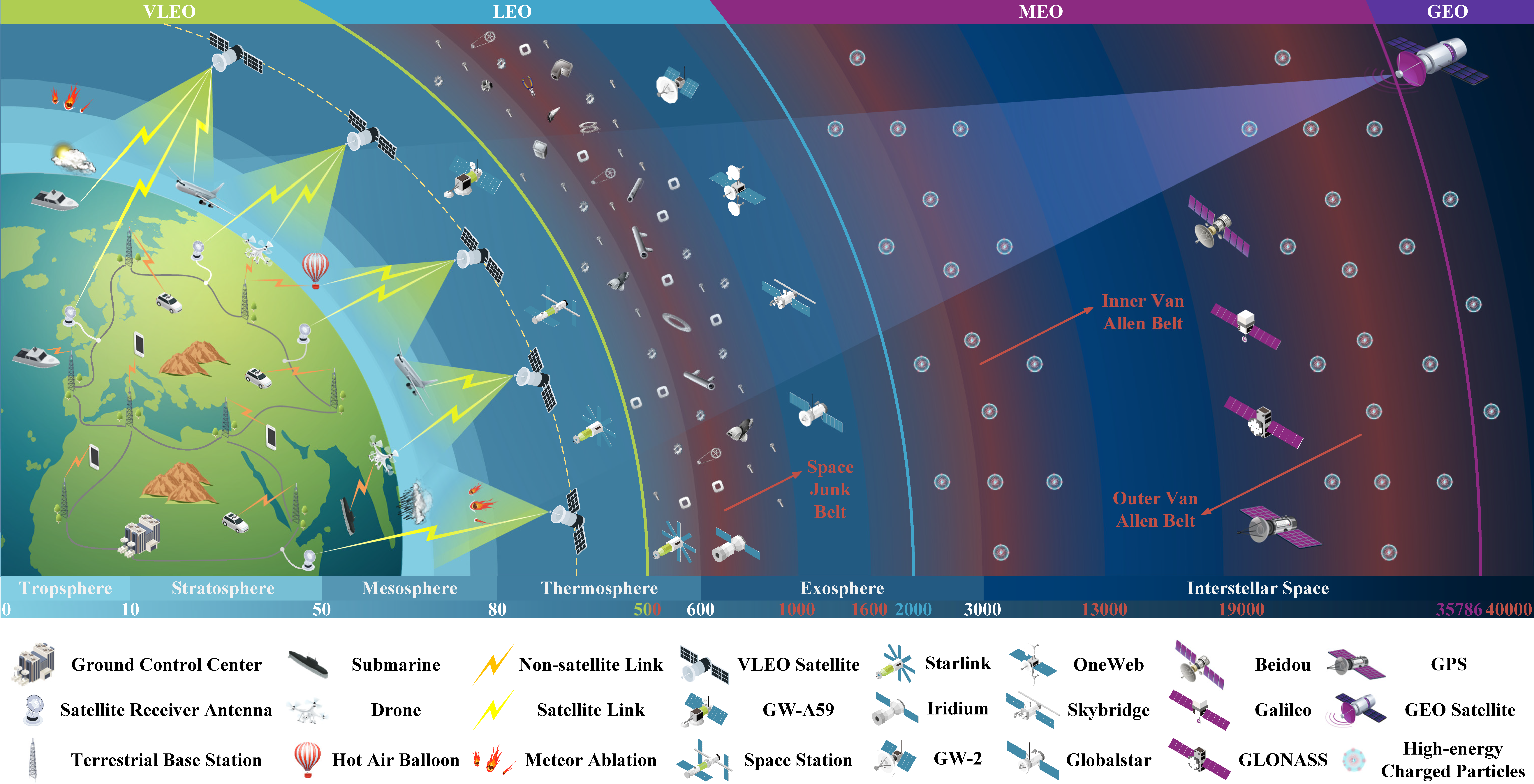
Fig. 1. SAGSIN architecture with VLEO satellite constellation. (GNSS in the MEO layer and geosynchronous satellite system in the GEO layer are considered)
Abstract: Recently, the Space-Air-Ground-Sea Integrated Network (SAGSIN) attracts great attention due to its ability to provide high-speed communication services to aviation users (AUs) and marine users (MUs), with Low Earth Orbit (LEO) satellites play an essential role. However, available LEO space is nearly saturated and full of massive space junks, which, combined with the ultra-low latency requirements for future 6G, presents a significant challenge. To address this issue, we propose designing a Very Low Earth Orbit (VLEO)-based satellite network that efficiently serves AUs and MUs. We first create heat maps based on the actual collected data and generate a benchmark observation point model with grid point method. Then we propose an implicit multi-objective continuous multivariate optimization problem to achieve the maximum coverage with minimum VLEO satellites. To solve this problem, we build a constellation simulation system, using the idea of decomposition and polymerization combined with the elite strategic genetic algorithm (ESGA) of swarm intelligence optimization algorithm. Many simulation results are obtained, including the indication that the optimal VLEO constellation has the deployment features of large altitude and low inclination, and has better coverage performance for longitudinal distributed business. The constellation design process is also highly migratory for other non-terrestrial networks.